Hong Kong IPO Market Heats Up in the First Half of 2026: A+H Listings and Technology Firms Lead the Way
Keywords: Hong Kong IPO, A+H shares, technology companies, capital markets, fundraising, Hong Kong Stock Exchange
Introduction
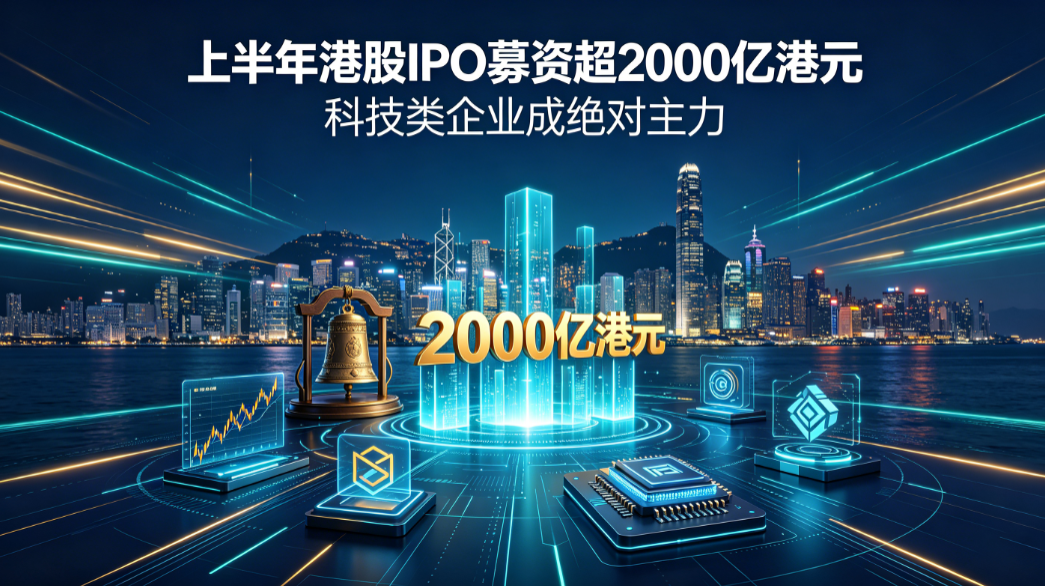
Hong Kong’s initial public offering (IPO) market has entered a noticeably stronger cycle in the first half of 2026. According to Wind data, 84 companies completed listings in the Hong Kong market during the period, raising more than HK$200 billion in total. Compared with the 42 listings recorded in the first half of 2025, the number of IPOs nearly doubled year on year, signaling a clear revival in market momentum.
The acceleration was particularly evident in late June, when 17 companies were listed between June 22 and June 30 alone. This dense pace of issuance reflects not only a stronger appetite among issuers, but also a more receptive market environment, improved liquidity, and renewed confidence from global and mainland investors. More importantly, the composition of this year’s listings suggests that Hong Kong is no longer merely recovering in volume; it is also deepening in structure.
A+H Listings Become a Major Force
One of the most striking features of the first-half IPO market is the sharp rise in A+H listings. In total, 24 mainland-listed companies sought secondary or dual listings in Hong Kong, doubling from the same period last year. These offerings accounted for more than 60% of total fundraising in the Hong Kong IPO market, making them the dominant source of capital inflow.
The strong appeal of A+H issuance is not accidental. For many leading mainland enterprises, especially in manufacturing, consumer technology, healthcare, and advanced industrial sectors, a Hong Kong listing offers several advantages. It provides access to a broader international investor base, enhances corporate visibility, and creates an additional financing platform at a time when companies are seeking resources for overseas expansion, technological upgrading, and global supply chain integration.
From a market perspective, the rise of A+H deals also reflects Hong Kong’s strategic role as a bridge between mainland China and international capital. Investors are increasingly willing to back companies with proven domestic business models, stable earnings profiles, and clear overseas growth potential. In this sense, A+H listings have become a high-quality channel for both capital raising and market validation.
Technology and “Hard Tech” Companies Dominate
If A+H listings represent one structural pillar, technology companies are the other. The first half of 2026 saw a pronounced concentration of IPO activity in sectors such as AI large models, semiconductors, advanced manufacturing, and other “hard tech” industries. In terms of listing numbers, these companies have become the clear leaders of the market.
This trend is closely aligned with the broader direction of capital allocation in Asia and globally. Investors are increasingly focused on companies with strong technological barriers, scalable industrial applications, and long-term growth potential. In a market environment where valuation discipline has become more important, “hard tech” firms are attractive because they are tied to strategic national priorities and can offer differentiated growth narratives.
According to Liang Youting, Vice Chairman of the Greater China Chapter of CPA Australia, the first half of the year saw 21 A+H projects, 29 TMT projects, and 13 advanced manufacturing projects. This demonstrates that the market is now supplying a richer and more layered set of high-quality assets. In other words, Hong Kong’s IPO market is no longer driven by a single sector or a narrow group of issuers; it is evolving into a more diversified capital formation platform.
Why the Market Is Strengthening Now
The current upswing in Hong Kong’s IPO market is supported by several interlocking factors.
First, the Hong Kong Stock Exchange has become more capable of accommodating different types of issuers. Its institutional framework for A+H listings, Chapter 18A biotech companies, and Chapter 18C specialist technology companies has matured significantly. This gives issuers more predictable pathways to market and allows the exchange to capture a wider spectrum of innovation-driven firms.
Second, secondary market conditions have improved. Higher trading activity and a gradual recovery in risk appetite have made the market more conducive to new listings. When investors believe they can achieve reasonable post-listing liquidity and valuation support, they are more willing to participate in IPOs. This, in turn, strengthens pricing efficiency and issuance confidence.
Third, capital flows are becoming more supportive. Global funds continue to look for exposure to China’s technology and industrial upgrading themes, while southbound capital from the mainland remains an important stabilizer of demand. Together, these flows help maintain the balance between supply and demand in the Hong Kong market, especially for large and strategically positioned issuers.
Annual Outlook Remains Optimistic
Looking ahead, major institutions remain constructive on the Hong Kong IPO outlook for the full year. Deloitte China expects Hong Kong to host around 160 new listings in 2026, with total fundraising of at least HK$300 billion. EY is even more optimistic, maintaining its forecast of HK$320 billion in total IPO proceeds for the year.
These projections suggest that the first-half rebound may not be a temporary spike, but rather the start of a more sustained recovery. If the current momentum continues, Hong Kong could once again position itself as one of the world’s most active fundraising venues, especially for companies from mainland China seeking an international capital base.
However, the path forward will still depend on several conditions. The pace of U.S. interest rate adjustments, geopolitical uncertainties, and global risk sentiment could all affect investor participation. At the same time, the quality of issuers will remain crucial. The market is increasingly selective, and only companies with strong fundamentals, clear growth stories, and credible governance standards are likely to achieve durable success.
The Deeper Significance for Hong Kong
Beyond the headline numbers, the revival of the IPO market has broader implications for Hong Kong’s capital market ecosystem. A stronger new listing pipeline can improve market depth, attract more institutional participation, and reinforce Hong Kong’s standing as an international financial center. It can also create a virtuous cycle: more quality listings improve sector diversity, which in turn supports liquidity and valuation discovery.
For mainland enterprises, Hong Kong continues to serve as a key offshore financing platform. For global investors, it remains one of the most efficient gateways to participate in China’s long-term technological transformation. This dual function gives Hong Kong a unique strategic value that few other markets can replicate.
At the same time, the market’s evolution toward A+H and hard-tech issuers is also a sign of structural upgrading. The days when Hong Kong IPO activity depended heavily on traditional sectors or pure liquidity narratives are fading. The new cycle appears to be shaped more by industrial policy, technological innovation, and cross-border capital demand. That is a healthier and more sustainable foundation for long-term market development.
Conclusion
The first half of 2026 has marked a strong and meaningful rebound for Hong Kong’s IPO market. With 84 listings, more than HK$200 billion in total fundraising, and a clear concentration in A+H and technology-driven issuers, the market has shown both scale and quality.
Looking ahead, the key question is not whether Hong Kong can continue to attract IPOs, but whether it can sustain the current level of high-quality issuance. On the evidence so far, the answer appears encouraging. As制度 capacity, market liquidity, and investor demand continue to improve, Hong Kong is likely to remain a central venue for China’s most competitive companies seeking capital, visibility, and international growth.
In this sense, the current IPO boom is more than a short-term market rebound. It may well represent the beginning of a new phase in which Hong Kong’s capital market becomes more diversified, more technology-oriented, and more closely linked to the next stage of China’s economic transformation.